
Aerospace Test Bench Design
Real-world insights from a test system development company
People often interchangeably use terms like “test rack”, “test rig”, and “test stand”. All these names refer to equipment used to test a device or product, generically called the Unit Under Test (UUT). These labels describe variations of the broader label of “test system” or “custom test equipment”.
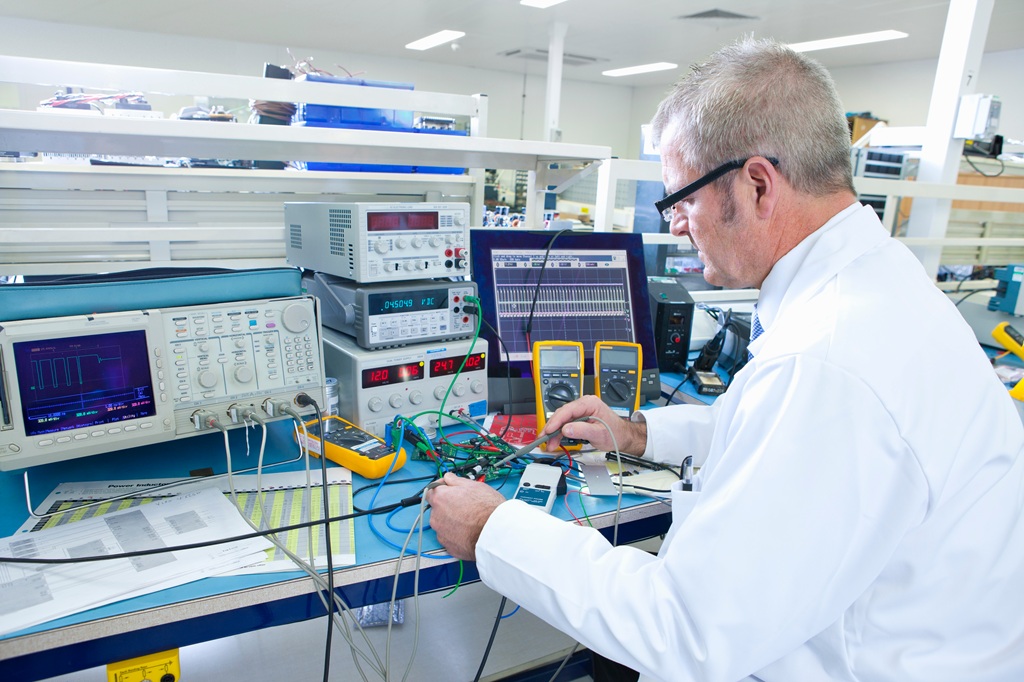
The distinguishing feature of a “test bench”, as compared to the other types of testers, is the location of the test equipment: it sits on a bench or a tabletop. The UUT might also sit on the bench, or it might be wheeled next to the bench on a cart. The main reason that test benches are used is because the test equipment can sit in a loose configuration on the bench or tabletop. The assembly of the parts on the test bench involves connecting via cables and/or harnesses. No mounting of components is needed. This arrangement brings flexibility to the test bench, which can make it easier to support testing of many different types of products by having the test operator choose which instruments need to be connected to each type of UUT. This offers flexibility for high-mix, low-volume manufacturing companies.
Test equipment in a test bench configuration is connected via cables:
Some products under test might also need additional components beyond those that sit on the bench, such as:
Note that when making these extra components permanently part of the test system, we usually label the combination of the test equipment and these items as a “test rig” or “test stand”.
Aerospace parts tested on a test bench
Many types of aerospace parts are tested on a test bench. Validation test is an obvious case, where the types of measurements needed to qualify the design’s performance are still being decided. And, manufacturing test is also a good sue case when the quantities and/or types are measurements are managed by a small set of instruments. Examples of the types of aerospace products and subsystems often tested on a test bench include:
These components are small enough that the UUTs can be wheeled next to the test bench. Contrast these with aerospace ailerons, assembled jet turbines, assembled landing gear, and other large and complex assemblies, which would require a test rig.
Common types of tests executed on an aerospace test bench
With such a wide range of product types, the types of tests are commensurately wide ranging and include quantifying functionality like:
Most of these tests can include both static and dynamic aspects:
- static measurements result in a single numeric value, and
- dynamic measurements require a waveform of values versus time to assess the behavior of the UUT under a transient or active operation.
Both static and dynamic tests may be needed to assess the functionality of the UUT.
Common aerospace test bench components
Aerospace test benches usually consist of the following categories of components:
- standalone measurement equipment
- cables
- a PC
- test software
Examples of commonly used measurement equipment:
Sensors are placed between the UUT and the analog measurement equipment to convert a physical parameter into either a voltage or current that the measurement equipment reads. Digital bitstreams and communication interfaces are usually connected via cables with standardized connectors, just DB-9 and RJ-45.
What’s easy and what’s hard to implement when designing / developing an aerospace test bench
We’ve been helping our clients with test benches since ~1993. We’ve learned some things along the way.
Some easy (or at least on the easier side) aspects are:
Some hard (or at least on the harder side) aspects are:
Gotchas when designing and developing an aerospace test bench
Even items on the easier side need careful consideration. Here’’s a list of items that will squander time and resources if not given decent thought:
Requirements
Insufficient details for the test requirements and an understanding of the impacts of associated measurements and sensors can lead to improper selection of measurement hardware. Details such as resolution, scan rates, dynamic range, noise floor, and signal types affect hardware and sensor selection.
UUT Specs
Incomplete documentation of test-relevant UUT specifications.
Flowdown requirements
Sometimes the product is being built to someone else’s requirements. Lack of or at least insufficient understanding of these “flowdowns” will lead to problems with the test bench hardware and/or software.
Reconciling old and new
If an obsolete test system is being replaced or upgraded, spending time to understand the differences in the existing and new hardware will eliminate surprises when new test data don’t match the older system results.
Test system used to simulate UUT controller
If a controller is connected to the UUT in normal operation, but the test system is used to simulate that controller, information about the controller model is crucial for fidelity of the test system to reproduce.
Primary POC identification
Identifying a point-of-contact to work between the test developers and the product designers will reduce waste and confusion between the teams.
Status updates cadence
Not having a cadence to update the entire team on progress and roadblocks.
Interconnect reliability
Not considering the wear and tear on interconnects causing intermittent electrical connections and/or failures, causing the test system to fault or return erroneous results.
Software development and maintenance practices
Not applying good software development practices. Using repositories and documenting the software used for the test application can be a huge timesaver in case changes are needed. The alternative leads to confusion about correct versions and misunderstanding on application operation.
System test plans
Not having a test plan before release. Improperly tested test software can lead to an ongoing nag of buggy software. Plus, if modifications are made in the future, running through a test plan can assure operation before releasing that new version.
How much does it cost to design and develop an aerospace test bench?
The short answer: As of 2026, ~80% of test benches we’ve delivered cost between around $40,000 to $400,000 USD (with the median falling somewhere around ~$80,000 USD). So, it depends.
The range for typical non-aerospace test benches is about half that cost. The increase for aerospace is primarily due to the rigor required by quality programs, which are in turn driven by regulations that surround aerospace manufacturers. In the U.S., these programs are influenced by the FAA, and quality standards, such as DO-178C and AS9100 and its variants.
To manage development costs in a regulated environment, whatever aspects we can leverage from you as the customer, will likely lower project costs. Some common examples that customers can bring to the project are:
- Complete and well-structured documents
- Labor for running Acceptance test and/or V&Vs and dealing with the test bench hardware
- Available test equipment for reuse / re-purpose
The documents that impact our costs most are requirements, design, and V&V (Validation and Verification) docs. The better these documents describe the goals, the lower our costs to implement, since we would need to spend less time determining what’s supposed to be delivered.
A common example of Viewpoint working with our customer to help mitigate costs deals with Acceptance Test associated with tracing the Requirements against the V&V documents, for example, does the test system measure the UUT temperature to the required tolerance and accuracy.
Sometimes we see our client including in their V&V a certain verification that is very hard to capture in an Acceptance Test step. For example, a V&V statement might say something like “to verify that the product meets this certain requirement, make this particular measurement”. But we have to point out that the measurement was not part of the initial requirements, creating a mismatch between what the test system can do and what is being requested in the V&V. Test system costs can increase, sometimes dramatically, because of such mismatches.
To save costs, Viewpoint often creates the V&V documents and associated Acceptance Test plan in conjunction with our client to manage the costs. Furthermore, to save additional costs, we often suggest that the client do the bulk of the acceptance labor and we step into a support role. This method has the added benefit of having an objective execution of the Acceptance Test plan versus using the team that wrote that plan.
How long does it take to design and develop an aerospace test bench?
For a brand-new design and build, most test benches will take at least about 6 months. If the test bench is a duplicate of a previous one or a close variant, then 2 months is possible. Like the cost discussion, “it depends”.
A significant addition to any project timeline stems from how well-versed the customer is in the world of product test.. For example, without a firm understanding of the way to test the product, Viewpoint must help our customer figure out how best to execute the test. Not knowing what’s possible and/or efficient in the realm of testing opens the door for our customers to ask for tests that are expensive and lengthy to implement.
This situation is especially prevalent for obsolete equipment, where any documentation on an existing test bench is lost, and the original designer has retired or left the company. Viewpoint is often called upon to provide reverse engineering to gain understanding of the existing test system. We might also write the requirements and design docs from scratch. This situation is common for us and we welcome working with customers as a team on obsolescence test system upgrades (sometimes called legacy migration).
Viewpoint’s approach to designing and building aerospace test benches
Our test bench design and build process looks like this at a high level:
- 1Review requirements (and work to create them if they don’t exist)
- 2Select appropriate measurement and control hardware
- 3Develop the test application software
- 4Integrate the hardware and software, debug, and perform initial testing the tester
- 5Deliver the system and do, or help with, the final testing
- 6Deliver final documentation, put documents and software in version control, and close out the project.
We can design and build the test bench. However, depending on the complexity, size, and requirements of the test bench, we may pull in a subcontractor to provide expertise and labor. When we follow that path, Viewpoint is the primary integrator and manages the subcontractor.
We have several subcontractor partners, ranging from:
Partnering expands the scope of projects we deliver and reduces costs by leveraging their experience and efficiencies.
As an example, say the product being tested needs a custom harness to connect to some I/O on your product and it needs a 1 kW electrical power supply to operate. All the test equipment can sit on the bench, but the power supply and UUT must be guarded due to the high level of electrical power. Viewpoint might engage two subcontractors:
- One subcontractor would make the custom harness to specifications we provide.
- The other might build a cabinet with connection interlocks and hardware to dump the energy from the 1 kW supply in an emergency, and guarding, such as light curtains, and “part present” sensors around the UUT to prevent inadvertent connections and access by the operator before, while, and after the test is in progress.
Next Steps
Want help designing your aerospace test bench?
In learning mode? Check these out:
- How Aerospace and Defense Manufacturers Can Make the Assembly and Test Process a Competitive Advantage
- 5 Keys to Upgrading Obsolete Manufacturing Test Systems
- 9 Considerations Before you Outsource your Custom Test Equipment Development
- Optimizing manufacturing test stations
- How to prepare for when your test team retires
- Commissioning Custom Test Equipment – Steps to take and gotchas to avoid
- What to do with your manufacturing test data after you collect it
- Improving Manufacturing Test Stations – Test Systems as Lean Manufacturing Enablers To Reduce Errors & Waste
- What should I keep in mind when I’m launching a new product and considering a custom manufacturing test system?
- What should I keep in mind when I’m launching a new product and considering a custom product validation system?
- Tips for improving manufacturing test with advanced test reports
- Tips for improving design validation with advanced test reports
- How to improve a manual testing process
